



When your child starts missing steps, struggling with balance, or skipping playtime, what should we look at first?
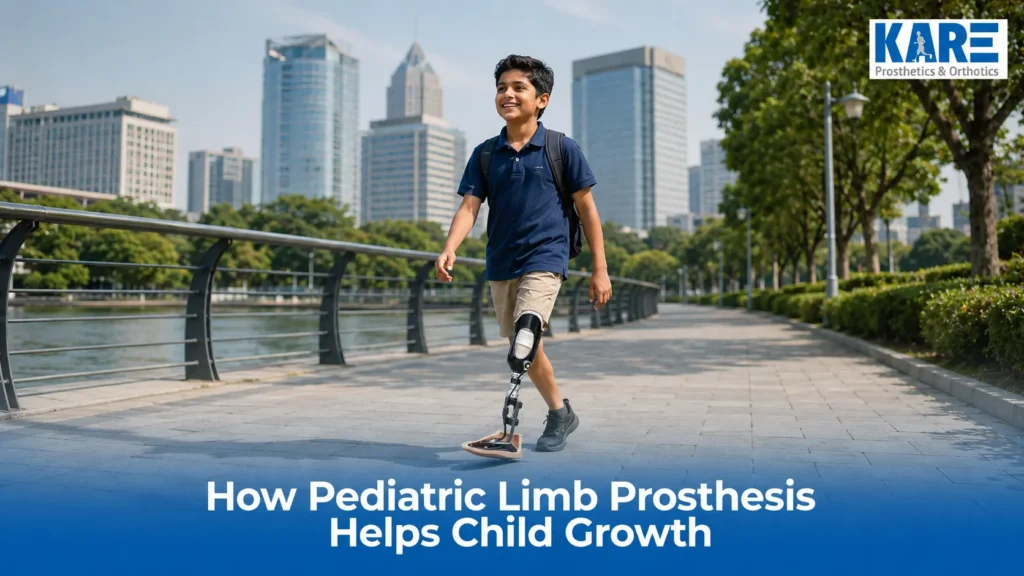
You do not start with appearance. You start with movement, posture, muscle use, and daily comfort. That is where pediatric limb prosthesis care changes a child’s path. The right fit can support safer standing, smoother gait, better body alignment, and stronger participation at home and school. It can also reduce the fear that many families feel in the first months after limb loss or a congenital limb difference.
A well-planned child prosthetic leg or upper-limb solution should match age, limb condition, activity level, and school routine. That is why good pediatric prosthetics work as part of a full care plan, not as a single fitting.
Why Early Support Changes the Way a Child Grows
Early support shapes how the body learns movement. When a child gets the right device and training at the right stage, the body builds cleaner patterns. The hips stay more level. The trunk works with less strain. The sound limb carries less extra load. As a result, standing, walking, sitting, dressing, and school routines feel less tiring.
This is even more important in India, where access still stays limited. A national review noted that only around 5% of Indian amputees get access to prosthetic devices. So, many children lose precious time for training, gait development, and follow-up care.
For that reason, families should look beyond a basic device. They should look for review cycles, socket checks, gait work, and proper pediatric prosthetic care. Good prosthetic limbs for children do not just fill a missing space. They guide growth, reduce compensation, and support body symmetry during key learning years.
Growth Milestones That Need More Than a Good Fit
Growth does not move in one straight line. A child changes in height, weight, balance, muscle tone, and confidence with tasks. So, a device that worked six months ago may stop working well now. That is why clinicians track function, not just fitting.
The table below shows how a limb prosthesis for a child’s growth should support each stage.
| Growth area | What the prosthesis should support | Why it matters |
| Standing balance | Equal weight transfer and stable base | Helps posture and cuts side bending |
| Early walking | Step length, knee control, and foot placement | Builds cleaner gait patterns |
| School activity | Sitting, stairs, and playground use | Keeps the child involved with peers |
| Hand use | Reach, grip, release, bilateral tasks | Supports writing, dressing, and eating |
| Fast growth phases | Socket checks and component changes | Prevents rubbing, pain, and poor gait |
| Sports and play | Shock control, energy return, secure suspension | Keeps movement safe and natural |
So, if you think only about walking, you miss half the picture. The device must support sitting on the floor, getting up, climbing a school bus step, holding objects, and moving through long school days. That is what separates a short-term fix from a long-term plan.
How Pediatric Limb Prosthesis Supports Everyday Development and Independence
A child grows through repetition. Every step, squat, reach, and turn shapes the body. So the prosthesis must support those small daily actions, because they are the foundation of bigger skills later.
Better Movement and Physical Balance
A well-aligned pediatric limb prosthesis helps the body share load evenly. The pelvis stays steadier, the spine works with less side shift, and the child spends less energy on every step. Balance improves during standing, walking, and turning, and the child begins to trust movement again, even in crowded school spaces.
Stronger Foundations for Early Walking and Active Play
Walking is not the final goal. Walking is the foundation for everything else. A properly tuned prosthesis supports push-off, step timing, and safer knee control. The child can then move into play, stair use, and outdoor activity with fewer delays. Good prosthetic limbs for children should match how children actually move in India, where stairs, uneven ground, and long school hours fill most days.
Faster Learning of Daily Tasks
Children learn by doing. So the device should support routine actions from day one, dressing, standing in class, carrying a school bag, and using both hands during play or study. Modern pediatric prosthetics can include cosmetic and myoelectric options when the child’s needs call for them.
Our pediatric range at KARE covers feet, knees, hip and modular components, liners, and cosmetic or myoelectric hand options built specifically for children.
Less Strain Across the Growing Body
When fit goes wrong, the body starts compensating. One shoulder lifts higher. One hip takes more load. The back twists. The sound limb works too hard. Over time, a small fitting issue can grow into a serious movement problem.
Many parents search “children’s artificial limb” online hoping for a fast answer. But the better question is whether the limb supports clean alignment, healthy skin, and even loading throughout the body.
A More Normal School and Social Life
Children do not grow in clinics. They grow in classrooms, on playgrounds, at family gatherings, and during sports periods. So the device must support attendance and participation, not just numbers on a gait lab report. Our pediatric care includes school discussions, family training, and activity planning, because we know that rehabilitation and psychological counselling belong right beside device fitting. Children and families both need support through this kind of change.
Steady Adjustment as the Child’s Body Keeps Changing
A child’s socket fit can shift quickly. Limb volume changes. Bones grow. Gait patterns evolve. Activity levels rise. A review published through NIH/PMC noted that children with limb prostheses face ongoing socket-fit and mobility challenges during rapid growth phases.
That is why we build planned reviews, socket relief checks, liner replacements, and component upgrades into every child’s care plan. A prosthesis for a growing child must anticipate change, never react to it late.
Choosing the Right Device for Long-Term Growth
The right plan starts with assessment, not product selection. First, clinicians check limb length, soft tissue condition, skin tolerance, joint range, muscle power, gait needs, and home routine. Next, they decide on socket style, suspension, component weight, and alignment. After that, they test the function through trial use.
For lower-limb cases, that may involve soft sockets, modular systems, paediatric knees, energy-return feet, or liner changes. For upper-limb cases, the path may include passive, cosmetic, body-powered, or myoelectric choices. KARE’s site shows paediatric feet, paediatric knees, and cosmetic or myoelectric hand choices, while its wider clinical messaging also points to biomechanics-led fitting and regular review.
Families should also ask clear questions. How often will you review fit? What happens when growth causes pressure? Can the socket be modified? Will school use change the design? Those questions help more than brand names alone. Many parents type children artificial limb into search bars first. Still, the smarter route is a full clinical plan that matches growth, activity, and follow-up.
How KARE Supports Pediatric Prosthetic Care in India
At KARE, we treat paediatric cases as a specialist service, not as a smaller version of adult fitting. Our KARE for Kids division focuses entirely on children, those born with limb differences, those who have experienced limb loss, and those with complex mobility needs. We say this often because we believe it: children are not small adults, and their care should never be approached that way.
Here is what our child-focused care includes:
- Customised fitting based on age, limb condition, comfort, and activity
- Rehabilitation and psychological counselling for both the child and the family
- Paediatric feet, knee systems, hip and modular parts, liners, and cosmetic or myoelectric hands
- Global technology support through trusted partners including Össur, Orthomerica, ST&G, and Becker Orthopedics
We also bring a strong clinical foundation to every case, grounded in biomechanics, material science, and long-term relationships with the families we serve. That is what Indian families deserve from advanced prosthetics and orthotics care, especially when growth, school life, and repeated adjustments shape the journey ahead.
Conclusion
Child growth does not wait, and neither should prosthetic planning. The right device can support posture, gait, hand use, play, school participation, and body symmetry through every stage of growth. More importantly, it should arrive with review, rehabilitation, counselling, and family guidance built right in. That is what turns a fitting into a growth plan.
If you want a pediatric limb prosthesis plan built around your child’s next stage, talk to us at KARE. We will guide the process with care that grows alongside your child.
FAQs
How often does a child need a new prosthetic limb?
Most children need reviews every few months. Full replacement depends on growth, fit, wear, skin changes, and activity pattern.
Can children play sports with an artificial limb?
Yes, many children can play sports. The prosthesis must match impact level, balance needs, surface type, and the child’s training stage.
At what age can a child start using a prosthetic leg?
A child can start once the clinical team confirms healing, readiness, and developmental need. Early fitting often supports movement learning.
How do prosthetic limbs support a child’s physical growth?
They support posture, weight transfer, gait pattern, balance, and daily participation. That helps the body grow with fewer harmful compensations.
What are the signs that a child’s prosthetic no longer fits properly?
Watch for redness, pain, loose suspension, skin rubbing, limping, shorter wear time, posture shift, or sudden refusal to use it.