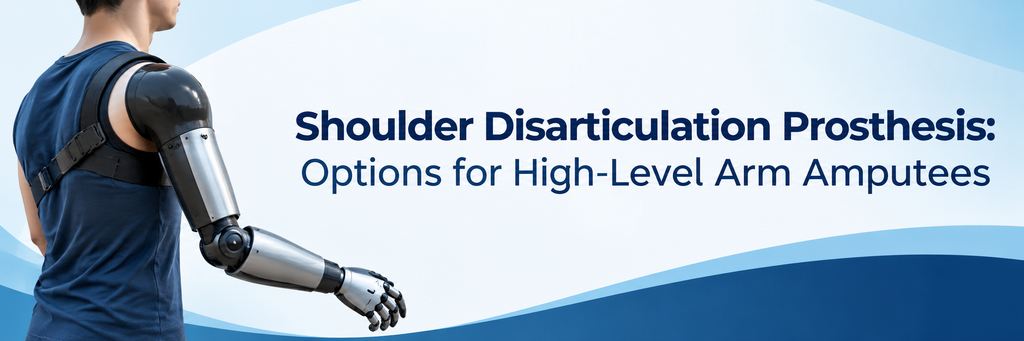
How do you replace an entire arm when no upper-arm segment remains? A shoulder disarticulation prosthesis replaces missing shoulder, elbow, wrist, and hand functions through one connected system. For someone living with a high-level arm amputation, those choices affect control, comfort, and daily use.
First, the socket must secure the system against your torso. Then, your prosthetist selects joint positions, control inputs, and the terminal device. Because each part affects another, fitting starts with muscle signals, work demands, and personal goals.
How a Shoulder Disarticulation Prosthesis Supports Daily Arm Function
At this level, every added joint creates another control decision. You may need the arm to hold, stabilise, or position objects. So, the prosthetist should build around repeated tasks.
Body-Powered or Myoelectric: Which Control Route Fits You?
A shoulder disarticulation prosthesis may use body-powered, myoelectric, hybrid, or passive control. Body-powered systems use harnesses and cables, while myoelectric systems read muscle activity. Hybrid designs combine methods when one input cannot manage several joints well.
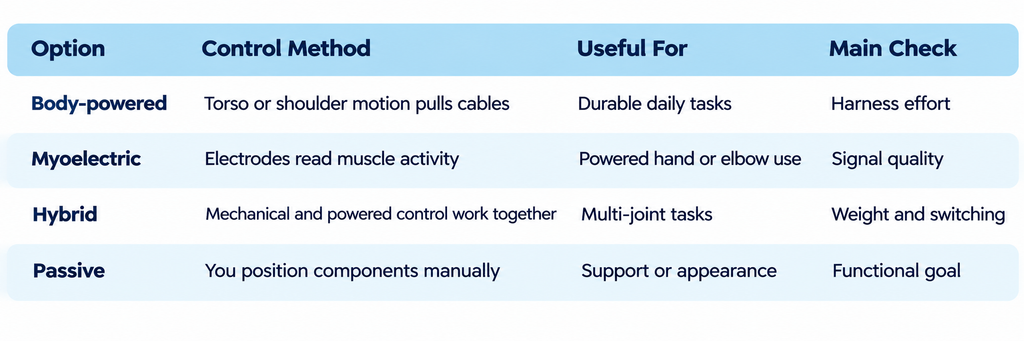
Before choosing, check how many actions one task requires. KARE explains electrodes, powered components, and fitting choices in its guide to myoelectric prosthesis.
Choosing a Shoulder Joint for High-Level Arm Loss
The shoulder unit sets the starting position for the whole arm. You may position a mechanical joint with the opposite hand or body movement.
For a shoulder-level prosthetic arm, this position changes your reach. Poor alignment can place the hand too far from a cup or work surface. Therefore, clinicians assess shoulder position and socket alignment together.
Elbow Control for Reach and Positioning
The elbow often handles the largest movement demand after shoulder positioning. Mechanical elbows use locking positions, while electronic elbows can respond to muscle signals. However, powered control brings charging needs and longer skill training.
Doctors may consider pattern recognition or targeted muscle reinnervation, known as TMR, for selected users. These approaches need specialist assessment. A Bengaluru study examined 23 patients with major non-traumatic upper-limb amputation, and 91.3% underwent above-elbow amputation. Two needed revision surgery. Surgeons chose shoulder disarticulation when postoperative muscle necrosis required a more proximal revision.
Picking a Hand for Daily Gripping Tasks
A simple terminal device can support firm, repeatable gripping. A myoelectric hand can open and close from muscle signals. Multi-articulating hands add grip patterns, but they also increase control demands.
With a prosthetic arm for total limb loss, hand choice cannot stand alone. The elbow must first place the hand near the target. Next, wrist position changes the grip angle. KARE explains these routes in its guide on how prosthetic arms work.
Socket Fit and Torso Support During Wear
At shoulder level, the socket often extends across the torso. It must spread load and limit rotation. Therefore, clinicians inspect pressure around the chest, shoulder blade, neck area, and nearby tissue.
Heat and skin friction can shorten wear time in Indian conditions. So, fitting should include reaching and task trials.
Managing Weight, Control Effort, and Energy Use
Every extra component adds weight. Yet removing a useful function can make tasks harder. Therefore, clinicians aim for the least complex system that still performs your priority activities.
A 2025 limb-salvage study followed 10 patients, and 1 patient, or 10%, later required shoulder disarticulation after local recurrence and pulmonary metastasis. Seven patients, or 70%, retained a functionally salvaged limb, while 40% developed metastasis. This small cohort does not represent national prevalence.
How Clinicians Select Components for High-Level Arm Loss
Good upper limb prosthesis options start with an assessment, not a product list. The prosthetist checks muscle activity, skin, torso shape, occupation, and key tasks. With complex upper limb prosthetics, one component can change another component’s control demands.
Matching Components to Anatomy and Muscle Signals
A shoulder disarticulation prosthesis needs stable attachment before powered joints can perform well. Electrodes also need repeatable contact with usable muscle sites. For that reason, clinicians test signals while you change posture and reach.
If signals remain limited, body-powered or hybrid control may work better. In selected cases, TMR can create additional muscle targets after surgical review. KARE covers amputation levels and component choices in its prosthesis guide.
Selecting Control for Several Joints
Multi-joint control gets harder when one input operates elbow, wrist, and hand functions. First, the prosthetist decides which joint needs active control most often. Next, the team chooses a switching method you can repeat without excess strain.
Some users prefer powered hand control with manual shoulder positioning. Others may prioritise an electronic elbow. Therefore, suitable upper limb prosthesis options can differ between users at the same amputation level.
Balancing Function, Weight, and Wearing Time
A heavier system may offer more powered functions, yet you still need usable wear time. So, clinicians should review component weight before final fabrication where possible.
This becomes important with a prosthetic arm for total limb loss. Weight moves farther from the torso as the elbow straightens. Consequently, socket stability deserves the same attention as electronic features.
Planning Around Work, Home, and Personal Tasks
Start with specific jobs rather than broad goals. You may want to hold a bottle, support clothing, stabilise a phone, or position material at work. Then the prosthetist can choose grips and joint positions around those actions.
A high-level arm amputation may need different strategies for office work and heavier activity. Therefore, one device need not perform every task. KARE covers hand types and grip choices in its guide to artificial hands.
Training Shoulder, Elbow, and Hand Control
Training begins with separate movements. After that, you connect them into short task sequences. For example, position the shoulder, flex the elbow, set the wrist, then close the hand.
With complex upper limb prosthetics, repeated task training can reduce unwanted torso movement. Therapists also teach donning, skin checks, battery care, and safe object handling.
How KARE Prosthetics & Orthotics Supports High-Level Arm Users
KARE has provided advanced prosthetics and orthotics in India since November 2013. We build custom prostheses rather than treating each user with an off-the-shelf limb. Our team evaluates, designs, fabricates, fits, and trains each user around individual needs. Our catalogue also includes shoulder-joint, electronic-elbow, and myoelectric-hand choices for this amputation level.
We use CAD/CAM, digitising systems, modern fabrication, and microprocessor technology when clinically suitable. Our clinical team includes American Board-certified professionals. Saravanan Sundarakrishnan also has US residency and clinical experience, and KARE states that he became Asia’s first clinician certified for HiFi interface socket fitting. That credential shows broader socket expertise, not a shoulder-specific HiFi claim. We also work with Össur, Orthomerica, ST&G, and Becker Orthopedics, while follow-up may include rehabilitation, adjustments, maintenance, and repair.
TEHLIN J-HT-006 Mechanical Shoulder Joint
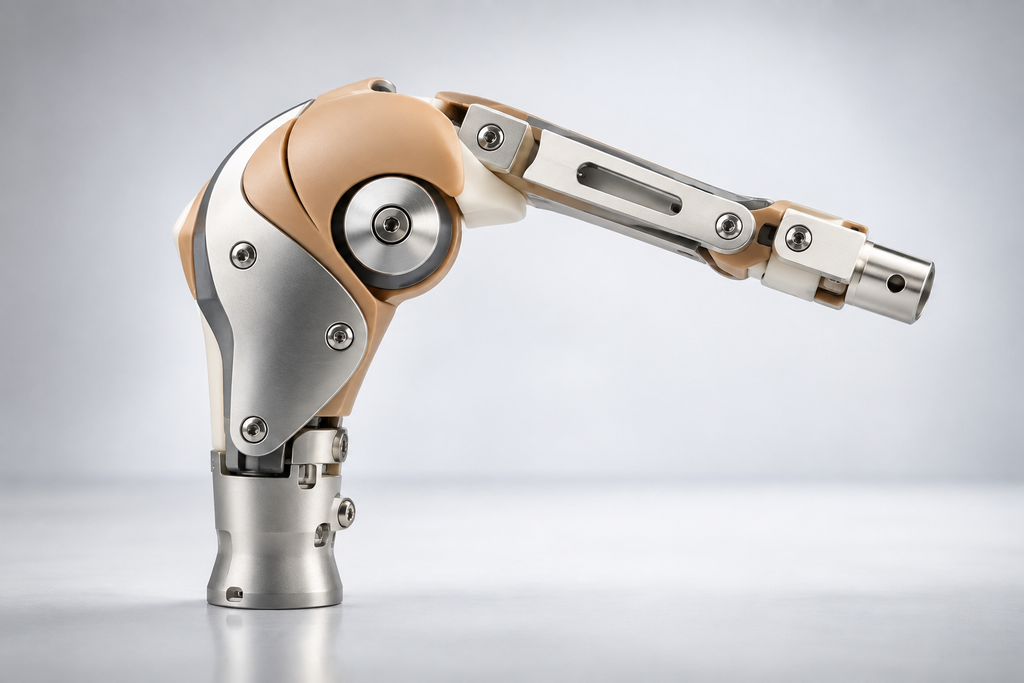
Our mechanical shoulder joint supports cosmetic, mechanical, and myoelectric configurations for shoulder-level fitting.
J-HTAE-03 Electronic Elbow Joint
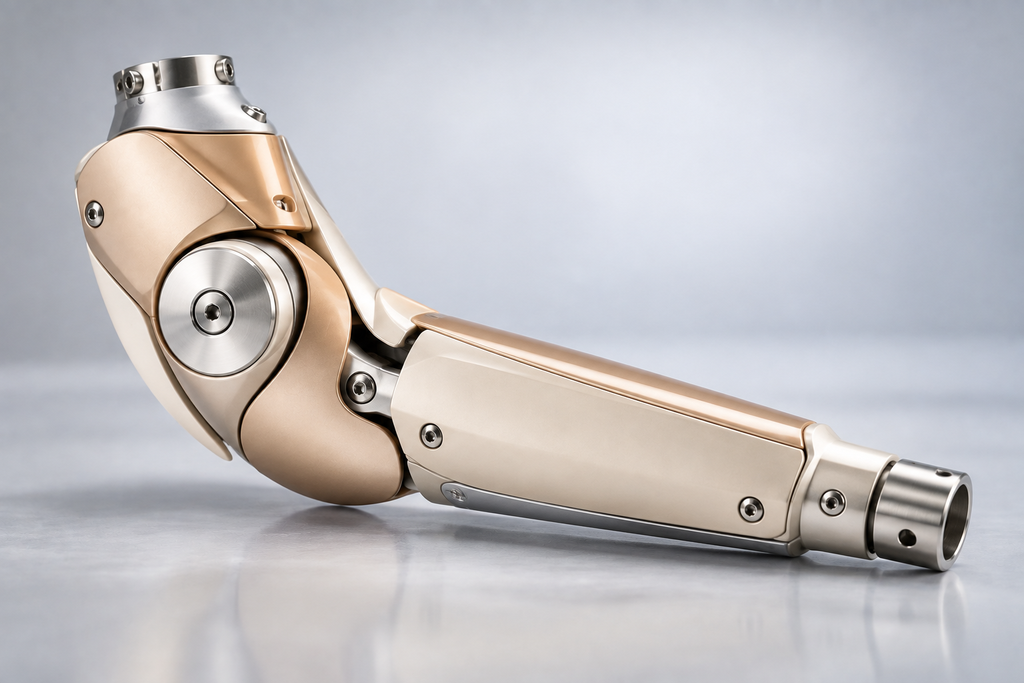
The electronic elbow joint supports myoelectric elbow control for transhumeral and shoulder-disarticulation users.
J-HT-01 Benatural Myoelectric Hand
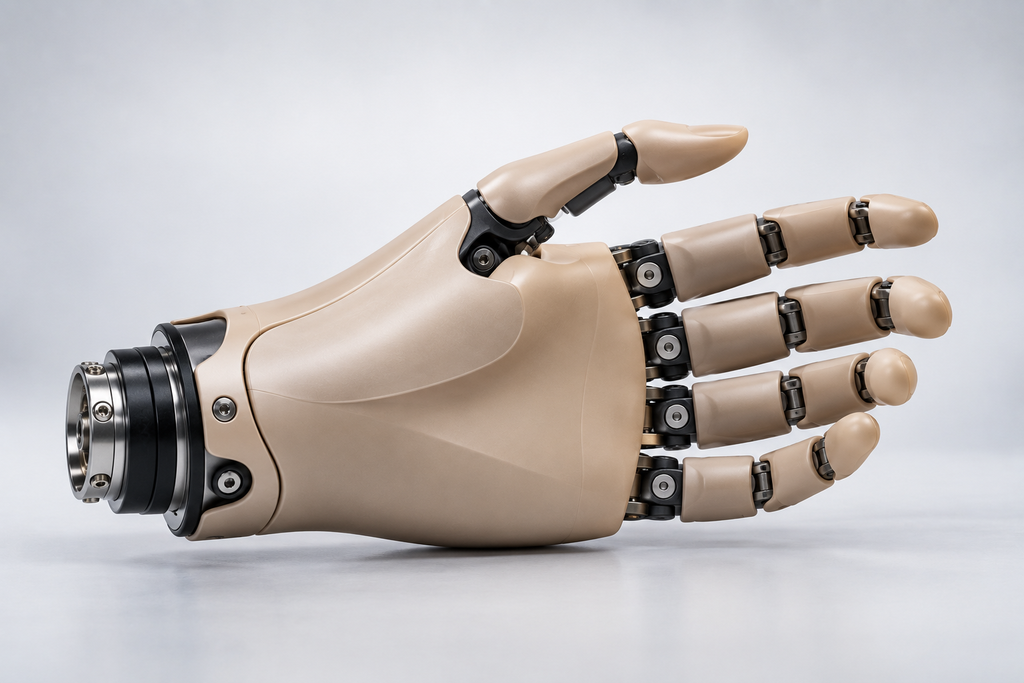
The Benatural myoelectric hand adds a powered hand choice within a shoulder-level prosthetic arm system.
Fitting and Rehabilitation After High-Level Prosthetic Care
Fitting begins with socket shape and suspension. Next comes alignment, component setup, and control training. Electronics cannot correct an unstable socket, so clinicians test the foundation first.
During rehabilitation, you practise arm placement before gripping and releasing objects. Later, training moves into home and work tasks. If needs change, the clinician can review socket contact, electrodes, or programmed controls.
When Should Your Prosthesis Be Adjusted or Reviewed?
Arrange a review when the socket moves, pressure marks persist, control becomes unreliable, or wear time drops. Also seek review after surgery, skin problems, or new work demands.
A device may still operate after its fit changes. Therefore, early checks can reduce compensatory movement.
Conclusion
High-level arm fitting needs careful choices across the socket, shoulder, elbow, wrist, and hand. At KARE, we plan around your body, muscle signals, and daily activities. Our team can assess your needs and plan a shoulder disarticulation prosthesis for daily use. Book a consultation with KARE to discuss your fitting and control options.
FAQs
What is a shoulder disarticulation prosthesis?
It replaces an arm lost through the shoulder joint, using a torso socket, shoulder unit, elbow, wrist, hand, and a suitable control system for function.
What prosthetic options exist for high-level arm amputees?
Options include passive cosmetic arms, body-powered systems, myoelectric systems, and hybrid designs. Your prosthetist matches components to muscle signals, tasks, comfort, wear time, and goals.
How is a shoulder-level prosthesis controlled?
A high-level prosthetic arm can work in several ways. Body movement may pull a cable, while electrodes pick up muscle signals. In some fittings, the wearer positions a joint by hand. Pattern recognition and hybrid mechanical-powered systems are other control choices.
Is training more intensive for high-level amputations?
Yes. Training starts with socket wear, posture, and single-joint control. Later sessions combine elbow positioning, grip use, skin checks, home tasks, and effort management.
Can users regain functional independence with this prosthesis?
Many users can improve independence after careful fitting and training. Results vary with amputation level, muscle control, prosthetic weight, goals, practice, and support over time.