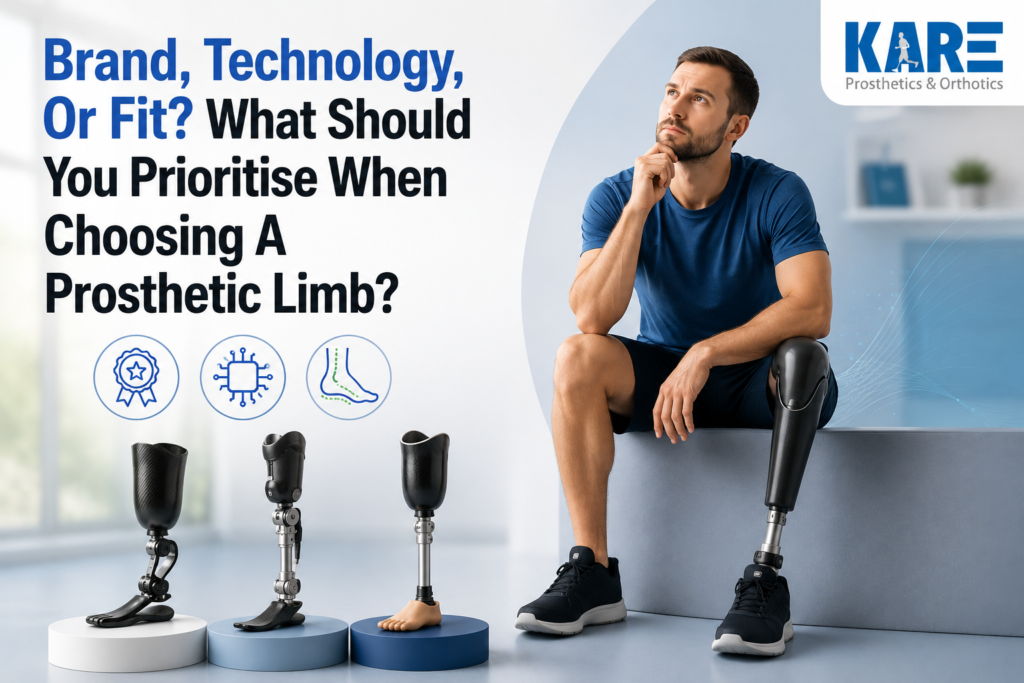
When choosing a prosthetic limb, can you walk, work, travel, climb stairs, sit on the floor, and spend a full day outside with it?
That question should come before brand names and glossy product photos. For many people in India, the process starts with fear, price checks, family advice, online searches, and clinic visits. Some users ask for the latest carbon foot. Some ask for a bionic hand. Others want the cheapest option because the budget feels tight.
This blog covers brand value, socket fit, daily movement, technology, trial fitting, gait training, and how KARE supports users through a complete prosthetic care journey.
A good artificial limb should support your body through ordinary days. It should help you stand in a queue, cross a road, travel to work, climb uneven steps, sit with family, and return home without severe pain.
What Comes First When Choosing A Prosthetic Limb?
The first decision should be function. Brand can come later. Technology can come later too.
A student in Bengaluru, a shop owner in Kolkata, a farmer near Mysore, and an office worker in Chennai may all need different limb designs, even with a similar amputation level. One person may need a light limb for home movement. Another may need stronger control for buses, uneven roads, and long working hours.
A 2025 systematic review reported that 49% to 95% of people with lower-limb amputation use a prosthesis. That range shows how common prosthetic use can be after limb loss. However, regular use depends on comfort, training, skin safety, and support after fitting.
Therefore, before asking for the best prosthetic limb, ask a better question. What should this limb help you do every single day?
Why Prosthetic Limb Fitting Should Come Before Fancy Components
The socket touches the residual limb for hours. So, even an expensive knee, foot, or hand can fail when the socket hurts. This is where many users face their first problem.
A socket should hold the residual limb with firm support. It should not pinch, rub, or create painful pressure. It should allow blood flow, protect the skin, and keep the limb stable during movement. Also, it should respect scars, bony areas, soft tissue, and daily volume changes.
A good fitting process includes proper measurement, casting, test socket trials, pressure checks, and alignment review. During this stage, the prosthetist studies how the user stands, walks, turns, and loads weight on the limb.
A made-to-measure limb should feel secure without feeling harsh. A loose socket can cause rubbing. A tight socket can cause pain, sweating, and wounds. Poor suspension can make the user fear each step. After that, many users reduce outdoor movement or stop wearing the limb for long hours.
So, socket design deserves more attention than the logo on the component. A good fit takes several steps. Read KARE’s guide to the stages involved in prosthetic fitting.
How Daily Movement Guides Prosthetic Limb Selection
Your walking pattern tells the prosthetist what your body needs. First, the clinician checks balance, hip strength, stride length, knee control, and weight transfer. Then, they assess ramps, steps, turns, wet floors, and uneven surfaces.
For lower-limb users, the foot type changes how the body handles impact. Some feet support slow and steady walking. Others support longer steps, quicker movement, and higher activity. A carbon foot may suit one person. A simpler foot may serve another person better.
For above-knee users, the knee system needs careful selection. A mechanical knee can work for basic movement. A hydraulic knee may suit users who need smoother speed control. A microprocessor knee can help selected users who require better stance support and variable walking speed.
Here, choosing a prosthetic limb depends on daily life. A person who walks mainly indoors needs one plan. A person who travels by metro, bus, auto, and crowded streets needs another. Also, Indian living conditions can change the decision. Dust, monsoon water, temple steps, office floors, farm paths, and long commutes all affect the final selection.
Foot type affects comfort and balance. KARE explains the main prosthetic foot types, features, and costs.
How Prosthetic Technology Options Should Pay For Themselves
Technology helps when it solves a daily problem. It should not add cost without use.
Microprocessor knees, energy-return feet, elevated vacuum systems, CAD/CAM sockets, myoelectric hands, and sensory feedback tools can improve control for selected users. Still, each option needs training, maintenance, service access, and the user’s active participation.
A 2025 sensory feedback review reported that 5 out of 11 users, about 45%, showed a clinically meaningful increase in walking speed on the 10-Metre Walk Test. This shows that selected feedback systems can support walking performance when the user receives the right training.
However, these technologies should match the user’s body and routine. A myoelectric hand may look advanced, but the user must charge it, train with muscle signals, and use it during daily tasks. If the user needs a simple grip, dust resistance, and easy repair, another design may work better.
Next, the prosthetist should check strength, balance, activity level, work needs, travel habits, and budget. Then, technology can enter the plan. Otherwise, the device may look premium but feel tiring.
Advanced features should support daily movement. Explore KARE’s guide to innovative prosthetic solutions.
Does The Best Prosthetic Limb Depend On Brand?
Brand value can help. A trusted brand may offer tested components, service support, spare parts, and proven designs. Yet, a brand alone cannot answer everybody’s needs.
The most suitable limb matches the user’s amputation level, socket comfort, movement goals, hand function, skin condition, and long-term service needs. A branded foot with poor alignment can still hurt. A costly knee without training can still feel unsafe. A high-end hand without task practice may remain unused at home.
This is why prosthetic limb selection should happen with a trained clinician. The prosthetist compares socket design, suspension, component class, weight, durability, maintenance, and cost. Also, they explain trade-offs in plain words. A lighter limb may cost more. A stronger limb may feel heavier. A high-activity foot may need better body control.
After that, the user and family can choose with less confusion.
How A Custom Prosthetic Limb Supports Longer Wear
A limb may feel fine for ten minutes inside a clinic. The test begins after half a day outside.
Heat, sweat, pressure, and fatigue can change everything. In Indian weather, users need special care with liner material, sock ply, hygiene, and skin inspection. A small red mark can turn into a bigger issue when ignored.
Balance also needs careful alignment. A small correction can reduce stress on the back, hip, and sound limb. For upper-limb users, extra weight near the hand can strain the shoulder. So, the limb should support use, not drain energy.
![[11:05 am, 08/08/2026] Ashalin A: Hii
[7:24 pm, 08/08/2026] Ashalin A: Table showing five factors to check when choosing a prosthetic limb: socket fit, component type, limb weight, training plan, and service access.](https://www.karepoindia.com/blog/wp-content/uploads/2026/07/image-9-1024x683.png)
After this review, prosthetic technology options become easier to compare. The user can see which feature improves walking, grip, balance, comfort, or service life.
Trial Fitting And Training Add Long-Term Value
Trial fitting gives the user a chance to feel the limb before final delivery. During this stage, the prosthetist can correct socket pressure, adjust height, change alignment, and review walking.
Good prosthetic limb fitting should never feel rushed. The user needs time to stand, walk, turn, sit, and report discomfort. Even small changes can improve comfort.
Gait training adds another layer of value. The user learns how to shift weight, bend the knee, climb stairs, handle slopes, and avoid poor body movements. Without training, even a good device may feel strange. With guided practice, the body starts trusting the limb.
For upper-limb users, training includes grip practice, object handling, cable control, shoulder use, or myoelectric signal training. Children need repeated reviews because growth changes fit and function. Adults also need follow-up when weight, activity, or skin condition changes.
Therefore, training should stay part of the treatment plan, not an optional extra. Training helps users walk with better control. Read KARE’s guide to walking with an artificial leg below the knee.
How KARE Helps With Choosing A Prosthetic Limb
At KARE, we design every custom prosthetic limb after evaluation, measurement, design, fabrication, fitting, training, and rehabilitation. Our prosthetists use hand casting, diagnostic tests, sockets, socket-fit checks, LASER alignment support, CAD/CAM, microprocessor prosthetic foot, elevated vacuum systems, and Hi-Fi socket interfaces when clinically suitable.
We offer advanced prosthetics and orthotics in India, including custom prosthetic legs, bionic hands, above-knee prosthetic systems, AFO braces, orthotic support, and flat foot solutions.
Our care model includes:
- Consultation, recommendation, treatment, user education, and rehab under one plan
- Accredited clinical support with access across Bengaluru, Chennai, Mysore, Kochi, Kolkata, Hyderabad, Thiruvalla, Durgapur, and Calicut
We provide international-quality prostheses and orthoses to people with disabilities while keeping Indian access, comfort, budget range, and follow-up needs in focus. From basic mechanical knees to hydraulic and microprocessor-controlled options, we help users choose with proper clinical guidance.
Conclusion
A prosthetic limb should help you move through your own day with less strain. So, start with assessment. Then check the socket fit, walking pattern, activity level, skin safety, training, and service support. After that, compare the brand and technology.
Some users need a simple and durable limb. Some need advanced control. Others need a lighter design, better suspension, or a new socket. The right answer comes from clinical assessment and daily use, not from price alone.
For expert support in choosing a prosthetic limb, book a consultation with KARE. We assess, design, fit, train, and support your recovery with care that stays personal.
FAQs
What should you check before choosing a prosthetic limb?
Start with your limb level, skin condition, daily travel, work routine, socket comfort, budget, clinic access, and the training plan after fitting.
Why should fit come before the brand name?
Fit decides how long you can wear the limb. A known brand still needs accurate measurement, alignment, socket checks, and guided walking practice.
How can you pick prosthetic technology for daily activities?
Choose technology after checking your walking distance, stairs, workplace floor, hand tasks, charging needs, repair support, and how much training you can follow.
Are expensive prosthetic limbs always the better choice?
Not always. A higher price can add features, but the limb must suit your body, skin, strength, climate, service access, and routine.
Why should a prosthetic assessment come before limb selection?
Before selecting a limb, the prosthetist must check your skin, strength, balance, and daily routine, because these details decide comfort and safe use.