Worried about a flat spot on your baby’s head? You are not alone. Many parents notice a change during the first few months, then wonder whether it will settle on its own or need expert care.
When parents search for plagiocephaly vs. brachycephaly, they usually want one simple answer. What exactly is the difference, and what should they do next? That question deserves a proper answer, because one pattern causes side flattening, while the other creates a wider, shorter head shape. Both can fall under flat head syndrome, yet they do not look the same, and they do not always need the same plan.
This guide explains how a custom cranial helmet works, when doctors may suggest one, and where baby head shape correction fits into the bigger picture. If you are in India and want specialist support, early review can make the next step less stressful.
A Parent’s First Question in Plagiocephaly vs Brachycephaly
Most babies have soft skull bones. That is normal. The skull stays soft so the brain can grow fast in the first year. Because of that, outside pressure can shape the head for a while. A baby who keeps resting on one side may develop one kind of flat spot. A baby who spends long periods on the back of the head may develop another.
Doctors often start with the baby’s story. They ask about sleep position, feeding side, tummy time, premature birth, and neck stiffness. Then they look at the infant skull shape from above, from the side, and from the front. They also check ear position, forehead shape, and neck movement. This part is important because a specialist must rule out craniosynostosis before moving ahead with any orthotic plan.
Published data show why parents and clinicians take this issue seriously. Deformational plagiocephaly affects an estimated 15% to 20% of infants, while some studies report an incidence as high as 46.6%. That sounds high, yes. Still, it does not mean every baby will need a helmet.
Parents still checking early signs can refer to KARE’s blog on what is baby flat head syndrome.
What One-Sided Flattening Usually Looks Like
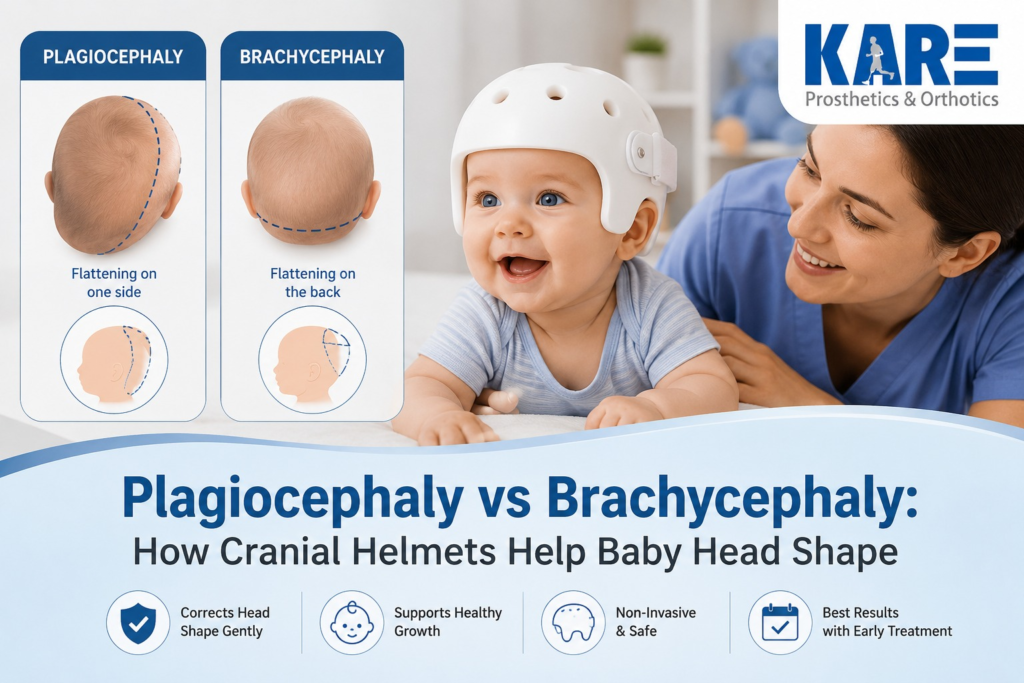
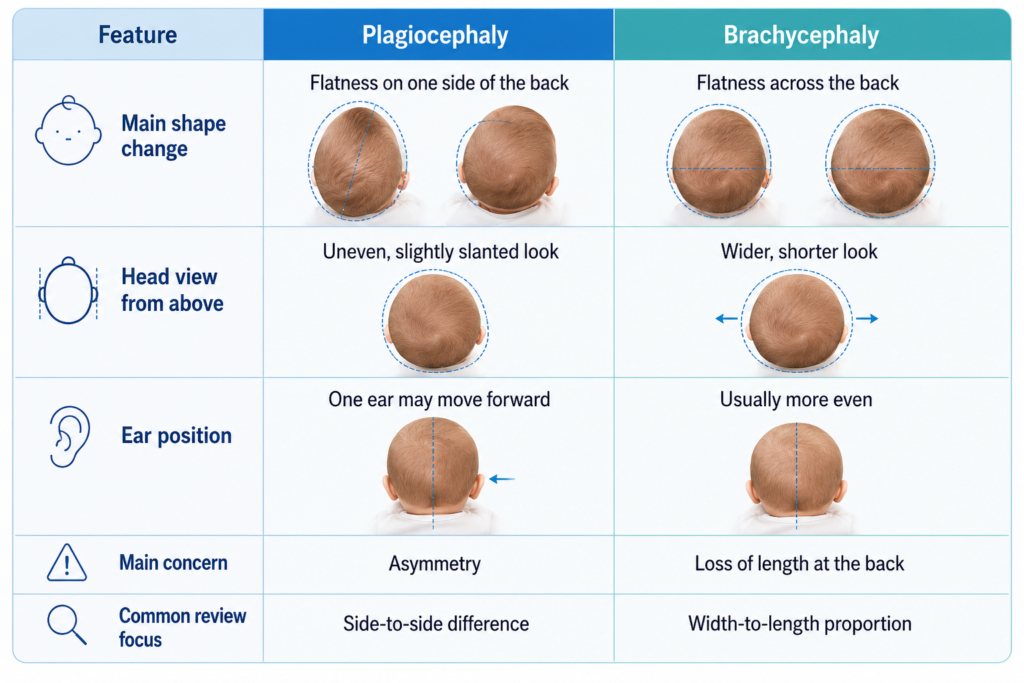
Plagiocephaly usually creates flattening on one side of the back of the head. The forehead on that same side may look a bit fuller. One ear may sit slightly forward as well. During plagiocephaly vs brachycephaly discussions, this is the pattern that often worries parents first, because the asymmetry shows up in photographs.
Doctors and orthotists do not rely on a quick look alone. They use head measurements, visual assessment, and, in some centres, digital scanning. Some teams record diagonal differences and track change over time with tools such as cranial vault asymmetry values. If a baby also has torticollis, which means tight neck muscles, the plan may include stretching and repositioning work with a therapist.
A 2025 study found 69.7% of affected infants had right-sided plagiocephaly, while 30.3% had left-sided plagiocephaly. So, right-sided flattening appears more often, though either side can occur.
Why a Wider Back-Flat Head Looks Different
Brachycephaly looks different. The back of the head appears flat across a broader area, not just on one side. The head may look wider when you view it from above. It may also look shorter from front to back. In many plagiocephaly vs. brachycephaly cases, this broad flattening links to long periods of pressure on the back of the head.
Doctors often look at width and length ratios here. They may use the cephalic index to judge proportion. This helps them decide whether the skull looks just a little broad or more than expected for the age. Again, one visual check is never enough.
Many parents use flat head syndrome as one big label for all these shape changes. That happens all the time. Still, proper naming helps because the treatment goal changes with the pattern. One-sided asymmetry needs one design approach. A broad, short skull needs another.
How a Cranial Helmet Helps the Growing Skull
A cranial helmet for babies does not press the skull into shape. That idea worries parents, but it is not how the device works. The helmet sits snugly over fuller areas and leaves a planned room where growth needs to go. As the skull grows, the head fills those open spaces. So the device guides growth. It does not force it.
That is why timing matters. The skull still grows fast in early infancy. A helmet works with that growth. If clinicians wait too long, the pace of growth drops, and the scope for shape change becomes smaller. This is one reason baby head shape correction often starts with early review, not late worry.
To see how helmet therapy works, go through KARE’s guide on how cranial remolding helmets treat flat head syndrome.
How a Custom Helmet Guides Growth
In plagiocephaly vs. brachycephaly, the design has to match the exact pattern. A baby with one-sided flattening needs room in one zone and support in another. A baby with a broad, flat back needs a different growth map. This is where custom work makes a big difference.
A specialist first captures the infant’s skull shape through digital scanning or precise measurements. Then the orthotic team creates a design based on that shape. Many centres now use 3D scanning because it records contour well and keeps the process easier for babies and parents. After that, fabrication starts. The result is a custom cranial helmet for babies, not an off-the-shelf shell.
For helmet fitting and shape correction details, KARE explains it in baby flat head helmet plagiocephaly treatment.
Why Fit and Daily Wear Shape the Result
Fit changes everything. A loose helmet shifts. A tight one irritates the skin. That is why the first fitting and later reviews carry so much weight. Parents receive a wear schedule, cleaning guidance, and signs to watch for, such as long-lasting redness or skin rubbing.
Helmet therapy for babies also depends on routine. Parents need to follow wear hours, attend review visits, and keep the helmet clean. In Indian weather, heat and sweat can make this part tricky. So, small habits help. Light cotton clothing, a cool room, and regular skin checks make daily wear easier.
Doctors may also recommend repositioning methods and neck exercises during treatment. The helmet does one job. The rest of the care plan supports it.
Parents planning daily wear can check KARE’s blog on baby helmet therapy for flat head syndrome
When Parents Start Seeing Changes
No good clinician promises a perfect result in a fixed number of weeks. Head shape changes at different rates. Age, growth speed, severity, torticollis, and daily wear all affect progress.
Still, families often notice small changes first. One side may start looking less flat. The forehead may look less prominent. The back of the head may begin to round out. In plagiocephaly vs. brachycephaly, those early changes tell the team whether the growth path looks right.
How We Support Cranial Helmet Care at KARE
At KARE Prosthetics & Orthotics, we support babies with plagiocephaly, brachycephaly, and other head shape concerns through a guided cranial helmet care process. We focus on proper assessment, custom fitting, parent guidance, and regular follow-up.
Our cranial care includes:
- Assessment of the baby’s head shape, growth stage, and visible flattening pattern
- SmartCam™ digital scanning for accurate head-shape capture
- STAR® cranial remoulding orthosis for eligible infants
- CAD/CAM-based fabrication through Orthomerica USA
- Custom helmet design based on each baby’s skull shape
- Fit checks, skin checks, and regular review visits
- Parent guidance on wear time, cleaning, redness, rubbing, and daily care
- Support through our clinic network across major Indian cities
We understand that helmet therapy for babies needs more than a device. It needs careful monitoring, timely adjustments, and clear communication with parents. At KARE, we help families move from confusion to a structured care plan built around the baby’s growth.
Choosing the Right Next Step for Your Baby
A flat spot does not always mean a helmet. Sometimes repositioning and neck work help enough. Sometimes they do not. That is why parents should not guess for too long. If the head shape keeps changing, if one side looks more prominent or if neck movement stays limited, speak to a specialist.
Start with a proper assessment. Ask what pattern your baby has. Ask how the team measures it. Ask whether they see torticollis. Ask what kind of review schedule they follow. Those questions help more than endless scrolling.
If you are looking for expert support in India, KARE can help you take that next step. For families comparing plagiocephaly vs. brachycephaly, we at KARE offer assessment, scanning, custom fitting, and follow-up care built around your child’s growth.
FAQs
What is the difference between plagiocephaly and brachycephaly?
Plagiocephaly causes flattening on one side of the head. Brachycephaly causes flattening across the back and makes the head look wider and shorter.
How do I know which head shape my baby has?
You may notice asymmetry, a flat back, or a wider head. A specialist checks head shape, ear position, forehead contour, and neck movement.
Can cranial helmets help both conditions?
Yes, doctors may suggest helmets for both patterns. The design changes with the skull shape, age, and level of flattening seen.
When should parents consult a specialist?
Parents should consult a specialist when the flat area grows, neck stiffness appears, facial asymmetry shows up, or repositioning does not help.
Does a baby’s head shape improve naturally?
Some mild cases improve with growth, tummy time, and repositioning. Moderate or severe cases may need closer review or orthotic care.